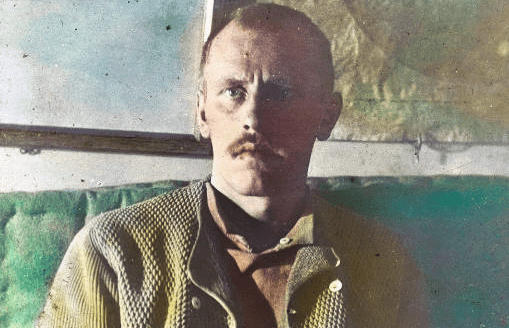
When I said in my opening blog post that I only became aware of Fridtjof Nansen in September 2025, that was only a half-truth. I say half-truth because I had, in fact, come across him on several occasions before, yet was completely oblivious at the time.
Let me explain…
As I also mentioned in that post, my doctoral research back in 2015-18 focused on Edwardian book inscriptions (Class, Culture, and Conflict in the Edwardian Book Inscription: A Multimodal Ethnohistorical Approach, to give the thesis its mouthful of a title). One of the real joys of this work, and the subsequent postdoc, was the data collection, or what I playfully called ‘the hunt’.
Unlike previous studies that relied on formal library collections, I gathered all my inscriptions from secondhand bookshops, particularly Oxfam (where I had previously worked as online shop manager) and BookBarn International (an incredible, if now sadly defunct, warehouse near Glastonbury packed with over 5 million books).
The process was pure fun, especially at BookBarn, where I’d enter with a hard hat and torch, climbing sky-high shelves in search of any books from 1901-14 with inscriptions inside. Once identified, I’d photograph them, take notes and later research the owners using archives. I still remember this as one of the fondest parts of my academic career to date.
Eventually, I collected a dataset of 3,000 inscriptions, growing to 4,500 during my postdoc. Since my Nansen ‘discovery’ in 2025, I found myself thinking often of that dataset, wondering if it contained any traces of him, given the time period. One rainy Sunday afternoon, I decided to go back and look through my dataset – and lo and behold, there was!
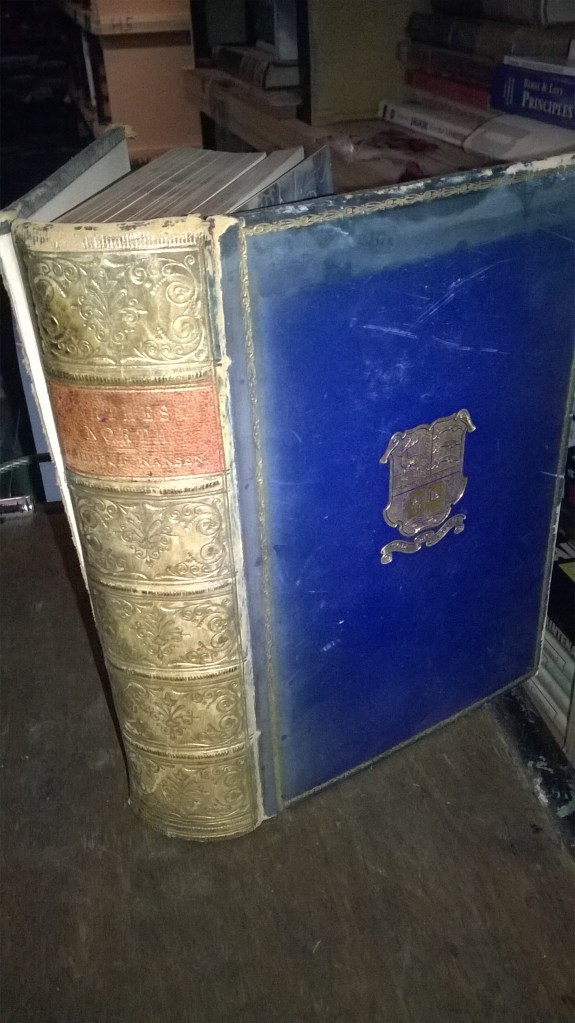
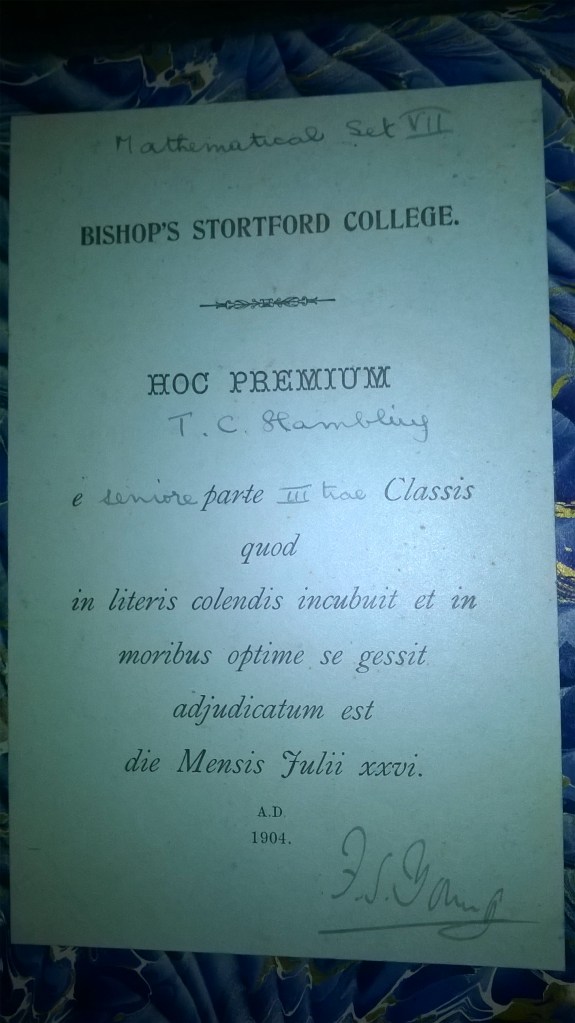
The first find was a gorgeous custom-bound edition of Farthest North, presented to T.C. Hambling of Bishop’s Stortford College in 1904 for success in Mathematics. Nansen’s Farthest North (Fram over Polhavet) was his first-person account of the Fram expedition, originally published in 1897, and became a bestseller across Europe. It was a popular choice as a prize book in boarding and public schools, no doubt because it promoted a particular type of heroic masculinity. This edition has blue leather boards with the school crest in gilt on its front cover and a patterned gilt spine. The recipient would later become a Captain in the 4th Battalion of the Worcestershire Regiment and embark for France in 1916.
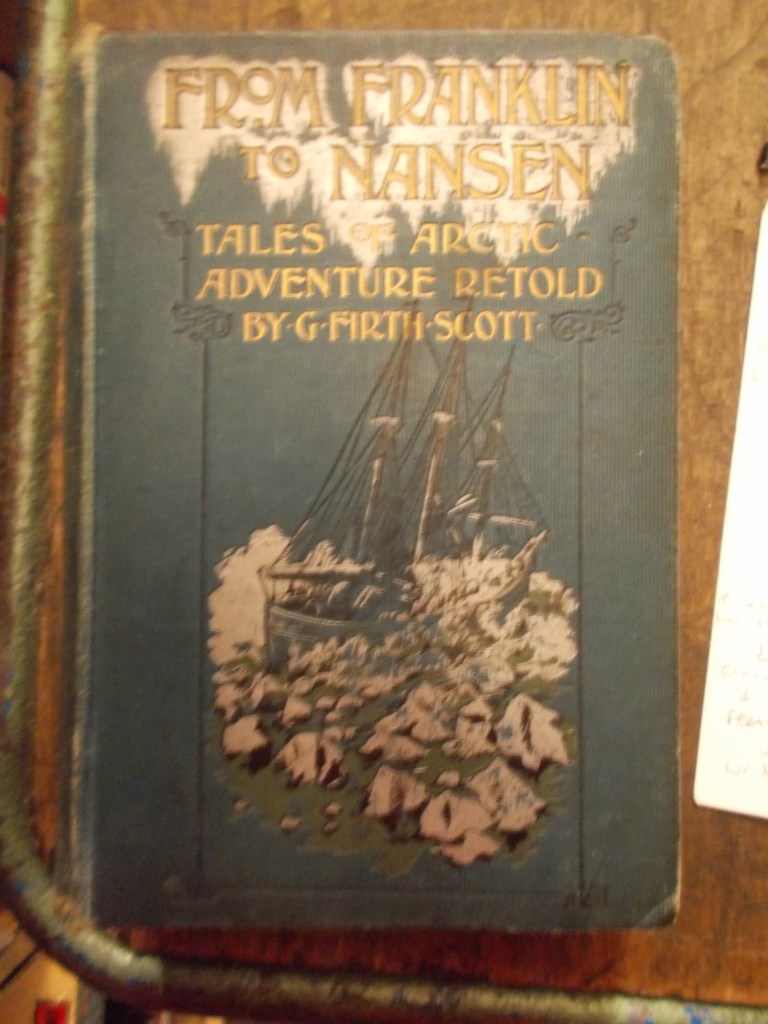
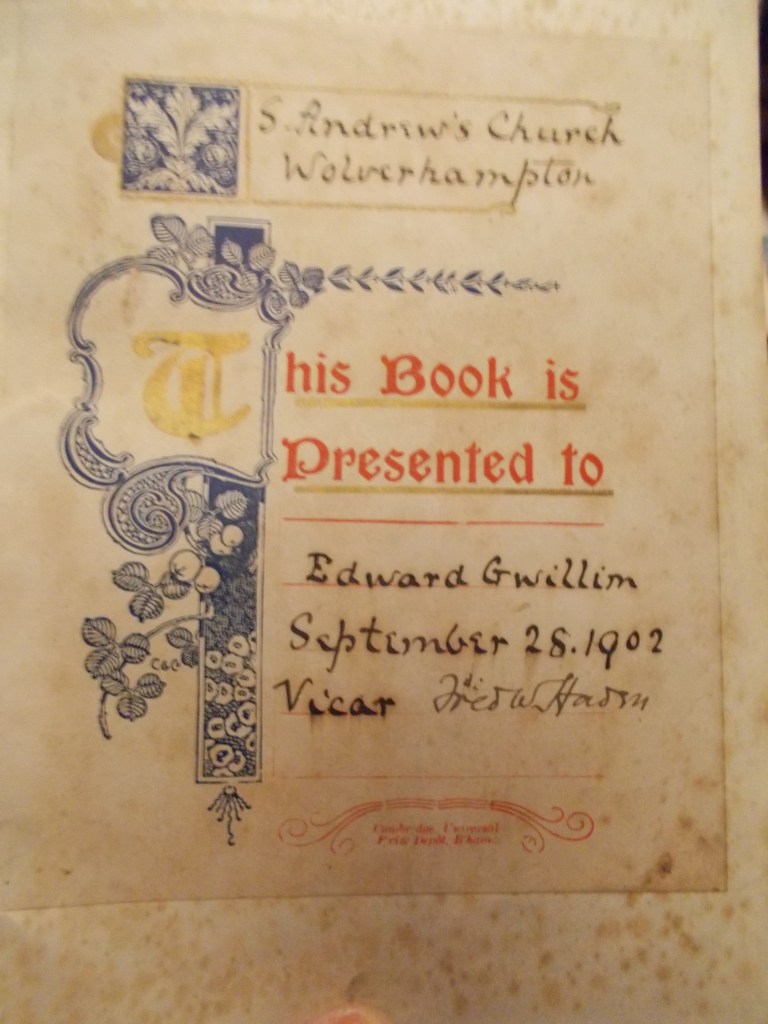
Another find was From Franklin to Nansen: Tales of Arctic Adventure, retold by G. Firth Scott and published in 1902 by C. Arthur Pearson Ltd. This one was more typical of the adventure prize books specially tailored to working-class boys: cheaply produced with colourful cloth boards to catch the eye, but containing finely compressed print on thin paper inside. It was awarded to Edward Gwillim by the Sunday School of St Andrew’s Church, Wolverhampton.
I was thrilled to rediscover these books and immediately remembered exactly where I had found them, even though I hadn’t realised their significance at the time. I decided I wanted my own Victorian or Edwardian book on Nansen.
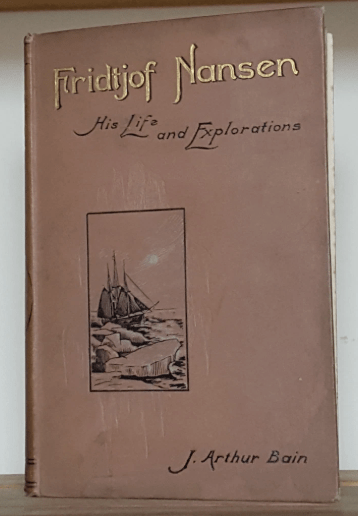
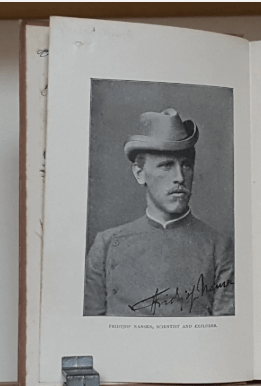
After several months of searching, I finally tracked down a copy of Fridtjof Nansen: His Life and Explorations by J. Arthur Bain, published by S.W. Partridge & Co. in 1897. It’s a charming children’s biography, produced immediately after the Fram expedition to capitalise on Nansen’s popularity. The book features brown cloth boards with gilt lettering, an illustration of the Fram and embossed ice on the cover. Inside, it provides a wonderful overview of Nansen’s life to date, with gorgeousillustrated plates throughout. It was once again a prize book, this time with a simple inscription: “To John Hardman for ‘good’ attendance” and “Bywell Schools” in the top-right corner. It’s a lovely edition to my ever-growing book collection.
Beyond book inscriptions, much of my academic work has explored historical advertisements. And here we get to my other unwitting encounter with Nansen! After my PhD, I took up a research position at Örebro University and joined a research group exploring food communication. I brought my historical perspective and chose to look at the concept of ‘pure’, especially before and after the landmark 1875 Sale of Food and Drugs Act in Britain, which clamped down on adulterated foods.
One of the lead proponents of ‘pure’ foods was Cadbury’s, who promoted their cocoa under the slogan “absolutely pure” to distinguish it from other products that were not. I spent weeks poring over historical newspapers to build a dataset of advertisements and I remember being intrigued by one in particular showing a man who I naively assumed at the time to be a Russian tsar. He had a fur coat, fancy moustache and toque-style cap and was bent over a steaming kettle adding cocoa to a cup. The accompanying text praised Cadbury’s cocoa for strength and flavour. I thought nothing of it at the time, adding it to my dataset and moving on to the next image. If I’d been paying more careful attention, I would have noticed the small illustration at the bottom of the Fram in pack ice and a small strapline noting “Dr Nansen’s Polar Expedition.” But nope, I was completely oblivious to the fact.
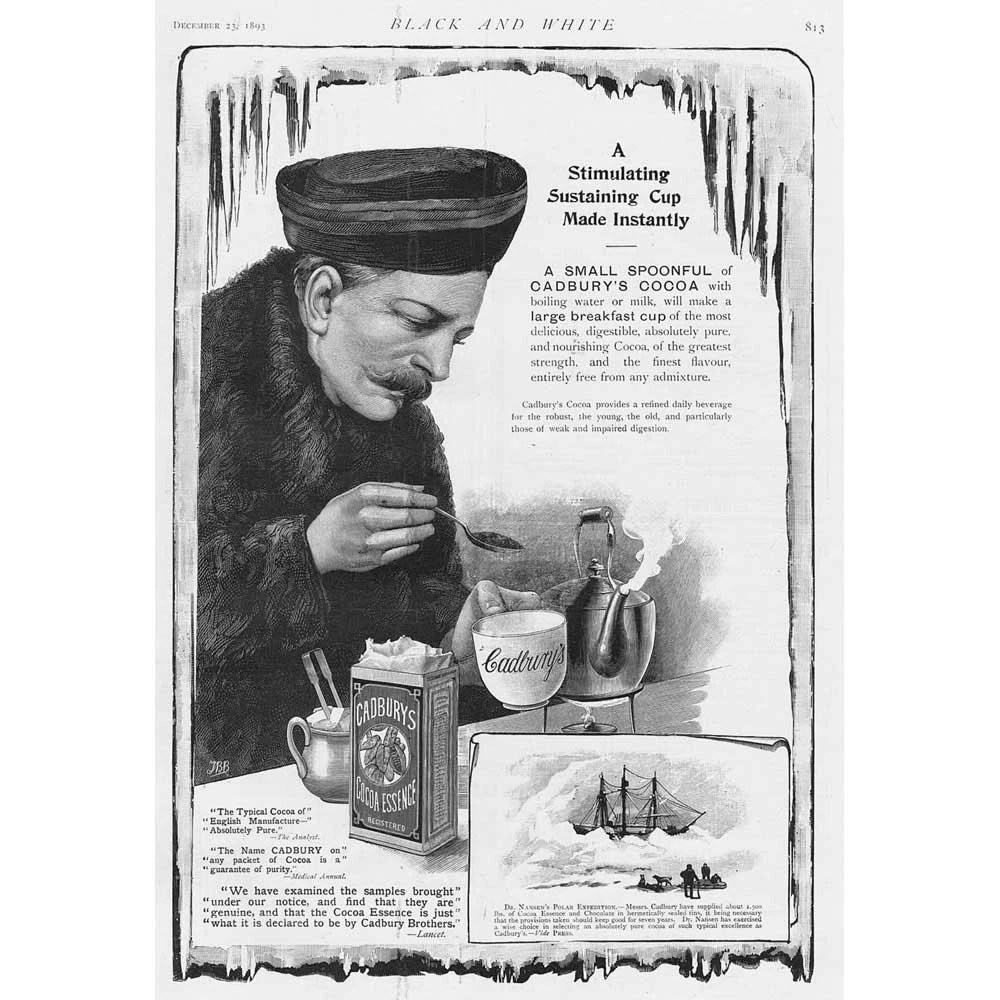
As I worked more with Cadbury’s advertisements over the years, I’ve often thought of that striking image. However, it was only when doing some recent work on endorsements by polar figures in food advertisements that I met this image again in the Cadbury’s archive and it immediately clicked: this was Nansen! Doh!
So there you have it: a few funny stories of how I indeed knew Dr Nansen, but just didn’t know it at the time.
 Forgotten Fridtjof
Leave a comment