We all have epiphany moments.
Sometimes they’re big, life-altering shifts – falling in love, finding the career that finally makes sense or realising you’ve outgrown the people around you.
But just as often, they’re quieter. More personal. Moments that subtly reshape how we see the world.
It might be the first time you hear an artist who stays with you forever (in my case, Rory Gallagher), an author whose stories feel like old friends (Jacqueline Wilson) or a TV show that comforts you like a warm blanket on a rainy evening (Seinfeld).
As a history buff, many of my own epiphany moments have come from a fascination with the past. I can still remember vividly, as a kid, the thrill of learning about The Romans… The Tudors… The Victorians… before gradually narrowing in on more specific figures and stories as I got older: Cicero, Emperor Hadrian, King Edward VII, Isambard Kingdom Brunel, RMS Titanic, Alfred Nobel, Marie Curie, Emmeline Pankhurst, Harry Gordon Selfridge, Wilhelmina Skogh…
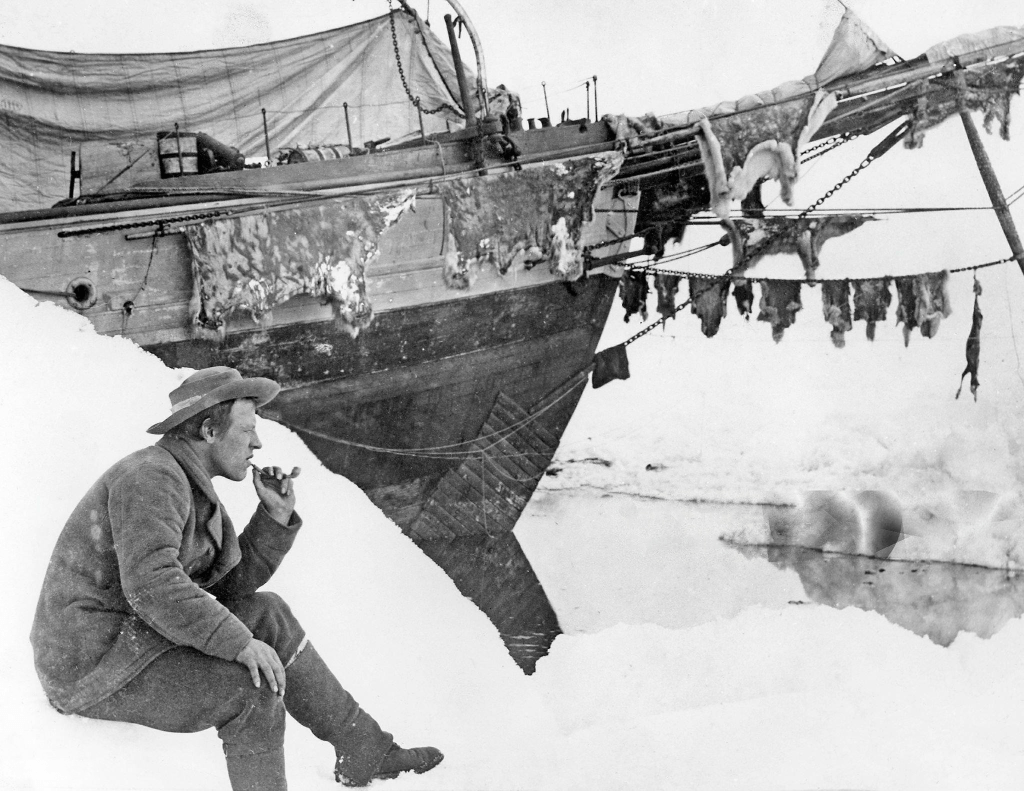
But nothing quite compares to the moment I ‘discovered’ Fridtjof Nansen on 17 September 2025.
But I’m getting ahead of myself. To set the scene, I need to go back ten years…
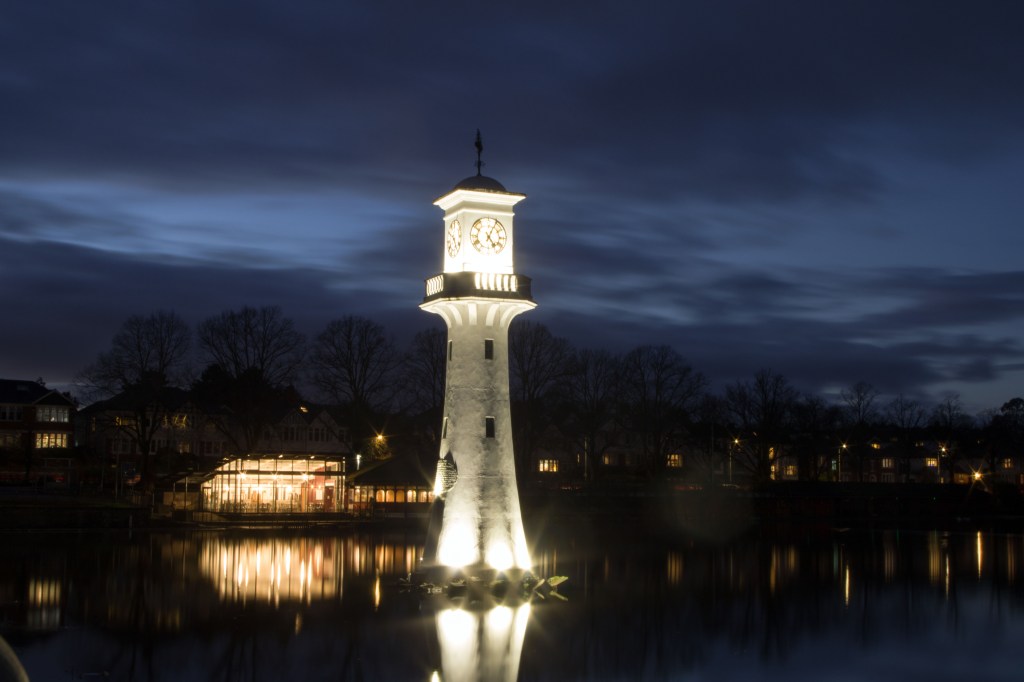
In 2015, I moved to Cardiff to study for my MA and PhD, and I guess that’s when my casual interest in polar exploration began. Living in the city from where the Terra Nova set sail in 1910, it was practically impossible to escape the shadow of Captain Scott. Roath Park has a commemorative lighthouse, memorial garden and Terra Nova café; the Bay has a monument and outdoor exhibition, City Hall has a bronze memorial; and even the Royal Hotel has a Captain Scott Room and a plaque noting that Scott and his men attended their last public banquet there.
Whenever family or friends visited Cardiff, we would do the rounds of these sites and discuss the expedition for a while, but I didn’t delve much deeper into polar history beyond that.
Then, in September 2025, I fulfilled a long-term ambition of visiting Oslo. I’m not sure why it took me so long. After all, I had been working for Örebro University since 2018 and the city was only a few hours across the border by coach. But I’m a firm believer that things happen at the right time for a reason.
While reading up on things to do in the city, one attraction kept coming up as the top pick – not just in Oslo, but in all of Norway (yes, even above the natural beauty of the fjords): the Fram Museum.
Now, given my interest in Captain Scott, I am contrite to admit that somehow I was not even aware what ‘Fram’ was. In all of the tributes around Cardiff, the name was quite simply never mentioned. When I read that it was the ship that Roald Amundsen used to reach the South Pole, I was intrigued. So, on 17 September, my partner and I set out for the Fram Museum, taking the ferry from Oslo City Hall across to the Bygdøy peninsula.
We stepped off the ferry and arrived at two tent-like buildings on the shore, home to the Fram and the Gjøa – the latter famously used by Amundsen to navigate the Northwest Passage. Walking inside, I was immediately overcome by the sheer presence of Fram.
I had grown up in Bristol with the SS Great Britain and the Matthew practically on my doorstep, and I had visited the Titanic Museum and SS Nomadic in Belfast countless times when back in Northern Ireland to see family. But seeing a ship like this right in front of you as you walk in a building was something else. In fact, I was completely taken aback by the impact it had on me, looking up and witnessing it there in all its majestic glory.
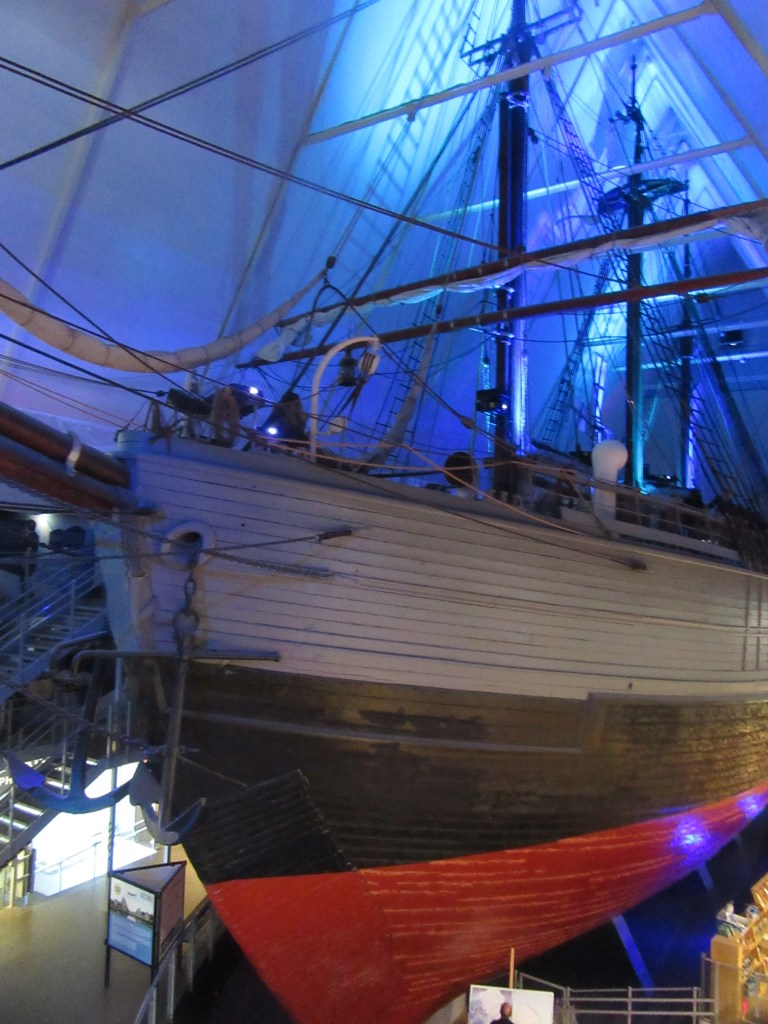
Visitors have full access to the Fram, and we spent hours wandering around the ship taking in every detail of its innovative design. The museum offers a fully immersive experience, with projections on its walls and ceilings, sounds of roaring storms, creaking ice and engine rumbles, and even physical effects like blasts of wind and subtle shaking, all recreating that harsh polar environment. Walking through it, I couldn’t quite compute that this was the ship that carried Amundsen to the South Pole.
Of course, it wasn’t until I left the ship and explored the incredible exhibition across three floors that I realised the Fram had an even richer past. It had originally been built by Colin Archer for the Norwegian explorer Fridtjof Nansen in 1892, for his daring attempt to reach the North Pole. Nansen’s plan was audacious: the ship was specially designed to withstand the crushing pressure of the Arctic ice, allowing it to be intentionally locked in and drift with the ice pack. The idea was that, over time, the ice would carry the Fram close to the North Pole – a revolutionary approach to polar exploration.
To my great shame, I had never heard of this Nansen figure before, but his bold plan captivated me and I was eager to learn more. That captivation quickly turned into sheer awe as I discovered the full Fram saga.
After deliberately drifting with the ice in the Fram, Nansen and his companion Hjalmar Johansen eventually set out on a daring sledging journey towards the North Pole. Turning back at 86°14’N and facing brutal conditions, starvation and exhaustion, they, had a chance encounter on Franz Josef Land with the British explorer Frederick Jackson, which ensured they got back home safely against the odds. Their story has to rank alongside Shackleton’s Endurance expedition as one of the great tales of survival. Unsurprisingly, it cemented Nansen’s status as a national hero in Norway.
I then went backwards through the exhibition, reading about Nansen’s Greenland crossing in 1888, his pioneering efforts in skiing and his original scientific work in zoology and neurology, thinking that this man just kept getting better and better. But when I went forward again and discovered all he achieved after retiring from polar exploration, my jaw literally dropped.
Engaging in diplomacy to secure Norway’s independence and international recognition. Leading humanitarian efforts to assist refugees and displaced persons, including serving as the League of Nations’ High Commissioner for Refugees and creating the ‘Nansen Passport’ for stateless people. Recipient of the 1922 Nobel Peace Prize. And on top of that, returning to academia with a new focus on oceanography, making countless scientific discoveries. The sheer breadth and impact of his life was staggering.
I spent the rest of the day at the Fram Museum in wonder, reading and absorbing everything about the Gjøa, the Maud, the N24 and N25, but my mind kept circling back to Nansen. In Britain, we are taught about the ‘heroic sacrifice’ of Scott, the extraordinary bravery of Shackleton and the tragic mystery of Franklin, but the name Fridtjof Nansen had never come up. Why on earth not?
At the same time, I was frustrated with myself: how had I missed this man in my 34 years on the planet? How had he somehow passed me by?
And that, my friends, was the catalyst.
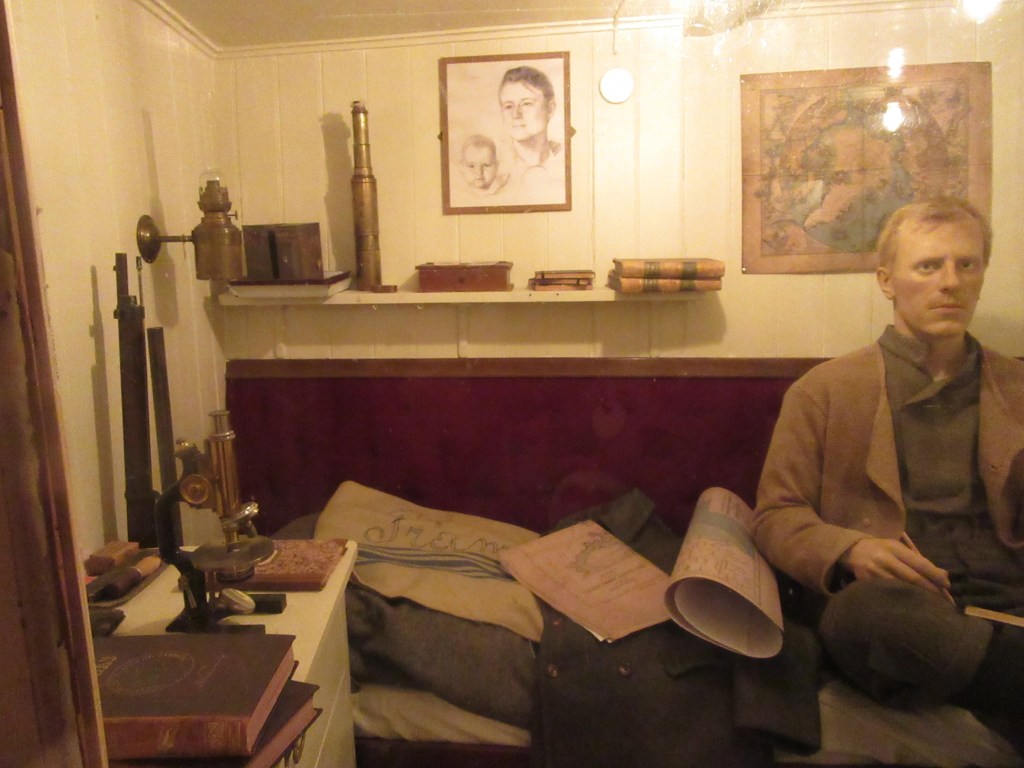
I left the museum and immediately started devouring everything I could find on Nansen. I suppose living with high-functioning anxiety has its advantages: I’ve always been able to hyperfocus, aggressively absorb information and retain facts – skills that certainly came in handy over the next few months!
All the polar exploration books I read made clear that visiting Nansen before any expedition had practically become a rite of passage, with his tacit approval being a badge of honour for explorers. The more I learnt, the more I wondered why on earth Nansen had somehow been forgotten today outside of his native Norway, and perhaps Russia and Armenia, with a few exceptions.
Since returning from Norway, I’ve bored my friends, family and colleagues with endless details about this extraordinary man. I’ve also found ways to bring Nansen – and polar exploration more broadly – into my academic work. As a sociolinguist specialising in visual and material culture, this has opened up new avenues for exploring the entanglement of objects, representations of heroism and cultural afterlives.
Since 2021, I’ve been running a project called Rewriting Rory, focused on the last ten years in the career of Irish blues-rock musician Rory Gallagher, which are often overlooked or misunderstood. In fact, most of my academic work has been about exploring the underrepresented or forgotten, starting from my PhD and postdoc research on class conflict and working-class book inscriptions in Edwardian Britain.
I felt the need to do something similar with Nansen and set up this little blog space to highlight the many facets of his extraordinary life. However, unlike Rewriting Rory, which has grown into a full-blown research project with detailed posts, interviews and collaborations with the Gallagher Estate, this space is far more informal. It will be a place for random musings, half-formed thoughts and reflections – sometimes serious, sometimes silly, and entirely sporadic.
And, of course, a place to point people the next time they look at me with a raised eyebrow and ask, “Nansen who?”
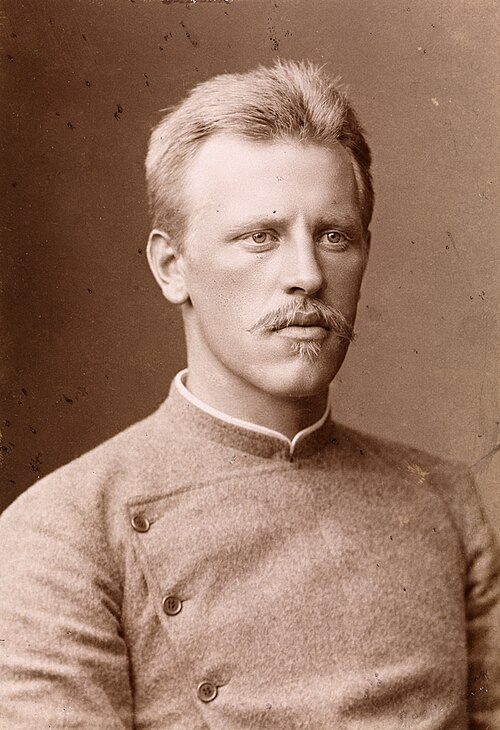
 Forgotten Fridtjof
Leave a comment