NANSEN THE CELEBRITY
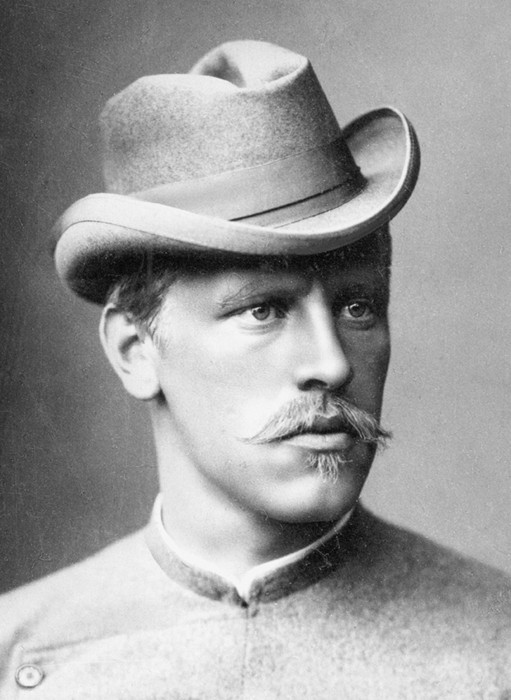
Fridtjof Nansen’s polar feats turned him into a global celebrity, his story sold, staged and celebrated across newspapers, lecture halls and even advertising campaigns.
In the late nineteenth century, polar exploration captivated the public. Tales of icy landscapes, life-threatening journeys and displays of masculine endurance turned expeditions into national spectacles and explorers into celebrity figures. Nansen was no exception.
The rise of mass-circulation newspapers brought Nansen into people’s homes, satisfying an insatiable appetite for adventure. Articles depicted him as the “modern Viking,” the epitome of masculine ideal: tall, physically imposing, with a piercing gaze. Yet they also presented him as a devoted family man. Photographs and illustrations of Nansen with his wife Eva and daughter Liv created the illusion of intimate access to his domestic life, an early form of celebrity culture. Eva, too, became part of the spectacle: her singing talent and patient devotion were portrayed as extensions of her husband’s heroism. Together, they embodied a marketable ideal – courage, intellect, and domestic virtue packaged for a public eager to consume adventure stories and aspirational lifestyles.
After the Fram expedition, Nansen embarked on lecture tours across Britain and the United States. The press reported excitedly on the arrival of “Dr. Nansen” – as they invariably called him – emphasising both his intellect and prestige. These lectures were more than scientific talks; they were performances. Nansen’s vivid stories of blizzards, polar bears and survival in subzero temperatures gripped audiences, while subtly reinforcing the expedition’s scientific importance. Behind the scenes, agents like Gerald Christy orchestrated every detail, from venues and ticket pricing to press coverage. Nansen was a high-value commodity and negotiated his appearances accordingly, earning sums that today would rival a blockbuster tour.
Women in particular were captivated by Nansen. Accounts describe them lingering after lectures, entranced by both his storytelling and his presence. There are even tales of them swooning or fainting before him. John Scott Keltie, librarian of the Royal Geographical Society, observed that walking along Regent Street or Piccadilly in his tight-fitting Jaeger outfit and pork-pie hat, Nansen “turned heads, not of one sex only.”
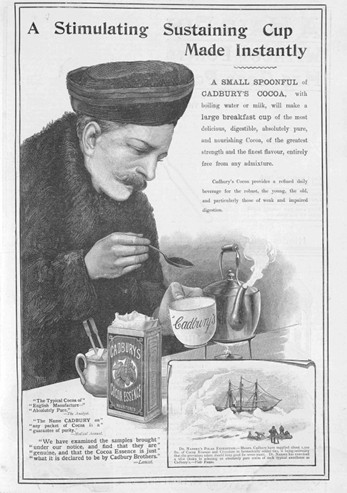
Nansen’s fame extended beyond storytelling into commercial culture. Advertisers and manufacturers quickly recognised the appeal of his persona, tying his image to everything from clothing to outdoor gear. References and images of Nansen appeared in advertisements for Bird’s Custard, Mazawattee Tea and Pears Soap, while Brierley Hill Cycles in Birmingham even launched a “Nansen” bicycle to appear fashionable. Clothing companies like Burberry and Jaeger were associated with him, though Nansen refused to provide formal endorsements, despite privately expressing satisfaction with their products. His most prominent commercial partnership was with Cadbury’s cocoa.
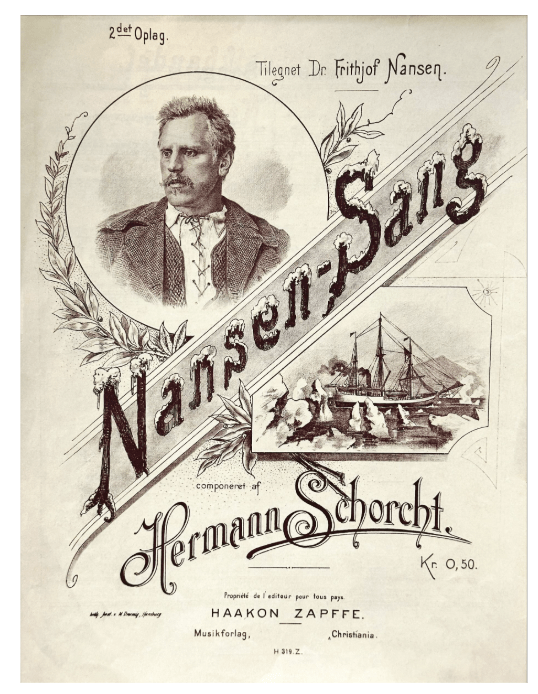
These highly visible representations of Nansen also found expression in popular culture, including souvenir prints, postcards and sheet music. Sheet music was performed not only on pianos in parlours within working- and middle-class homes but also at public events in theatres, dance halls, social clubs and parks. Its rapid and inexpensive production made the songs and their accompanying pictorial covers an effective means of conveying distant expeditions in musically and visually accessible formats. Songs about Nansen include ‘Hilsen til Grønlandsexpeditionen’, ‘Nansen-Marsch’, ‘Nansens Nordpolexpedition’ and ‘Fram-Sang’.
Nansen’s celebrity was also recognised formally. For his polar expeditions, he received awards and honours from countries across Europe and beyond, including:
• Norway:
– Knight of the Royal Norwegian Order of Saint Olav, 25 May 1889
– Grand Cross, 11 September 1896
– With Collar, 7 September 1925
– Fram Medal, 1896
– Coronation Medal of King Haakon VII and Queen Maud, 1st Class (Silver), 1906
• Sweden:
– Vega Medal, 1889
• Austria-Hungary:
– Grand Cross of the Imperial Austrian Order of Franz Joseph, 1898
• Kingdom of Bavaria:
– Grand Cross of the Merit Order of Saint Michael
• Denmark:
– Medal of Merit, in Gold and with Crown, 1897
– Knight of the Order of the Dannebrog, 24 May 1889
• France:
– Grand Gold Medal of Exploration and Journeys of Discovery, 1897
– Commander of the National Order of the Legion of Honour
• Kingdom of Italy:
– Grand Officer of the Order of Saints Maurice and Lazarus
– Grand Cross of the Order of the Crown of Italy
• Kingdom of Prussia:
– Carl-Ritter Medal (Silver), 1889
– Alexander von Humboldt Medal (Gold), 1897
• Russian Empire:
– Constantine Medal, 1907
– Knight of the Imperial Order of Saint Stanislaus, 1st Class
• United Kingdom:
– Patron’s Medal, 1891
– Honorary Knight Grand Cross of the Royal Victorian Order, 13 November 1906
• United States:
– Cullum Geographical Medal, 1897
 Forgotten Fridtjof