NANSEN THE EXPLORER
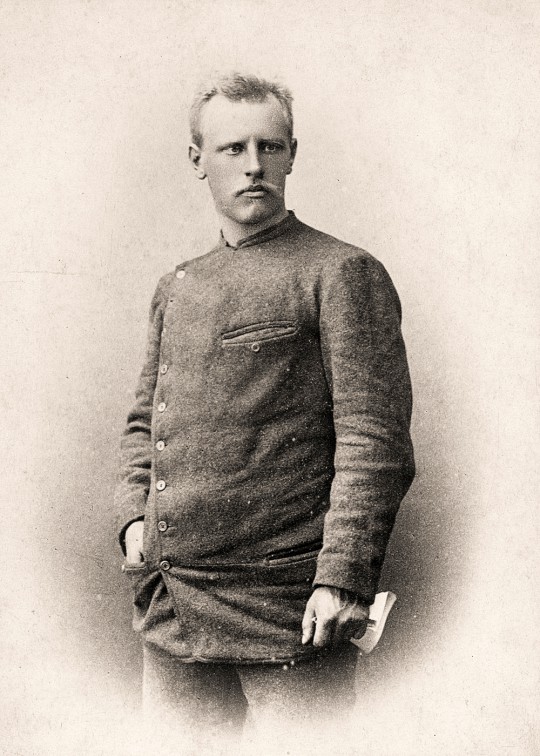
Fridtjof Nansen is one of the most celebrated figures in Arctic exploration, a man whose daring expeditions both pushed the limits of human endurance and revolutionised the way polar journeys were undertaken. He combined meticulous planning, scientific curiosity and innovative equipment to tackle environments that had previously been considered almost insurmountable.
Greenland Expedition (July-October 1888)
Nansen’s Arctic ambitions began while he was curator at the University Museum of Bergen. After completing his doctoral thesis in 1887, he began to envision a bold project: a crossing of Greenland’s icy interior. At that time, only a handful of explorers had ventured inland, and none had attempted a full east-to-west crossing. Previous expeditions, like those of Adolf Erik Nordenskiöld in 1883 and Robert Peary in 1886, had started from the west coast and travelled only about 160 kilometres inland before turning back. Nansen, by contrast, wanted to traverse the island entirely, finishing in the populated west rather than retreating to the dangerous eastern coast.
Rejecting the massive, manpower-heavy expeditions typical of the time, Nansen opted for a small, highly skilled team of six. He designed lightweight sledges, specially tailored clothing, sleeping bags and portable stoves, all optimised for speed and efficiency on the ice. The plan was controversial. Newspapers warned that such a scheme risked “uselessly throwing lives away,” and the Norwegian parliament refused to fund the project, wary of the danger. Nansen relied on private contributions, including a significant donation from Danish businessman Augustin Gamél and support from university students who helped fundraise.
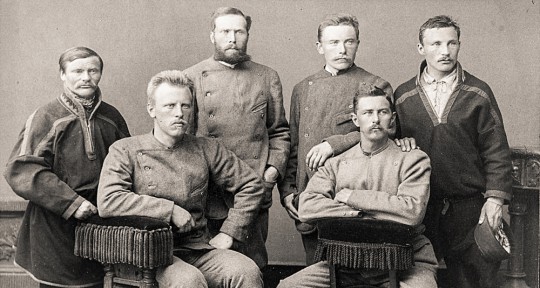
Recruiting the right team was critical. Nansen sought expert skiers, initially turning to Norway’s Telemark region but finding little success. He then followed the advice of Nordenskiöld and recruited two Sami men from Finnmark, Samuel Balto and Ole Nielsen Ravna, recognised for their skill on snow. The remaining team members were Otto Sverdrup, a former sea captain and forest worker; Oluf Christian Dietrichson, an army officer; and Kristian Kristiansen, an experienced outdoorsman and acquaintance of Sverdrup. All were seasoned in extreme conditions, skilled at skiing and familiar with the demands of outdoor life in harsh climates.
The team departed Iceland in June 1888 aboard the sealer Jason. They reached Greenland a week later, only to be met by dense pack ice that blocked their progress. After days drifting on ice floes and battling the treacherous conditions, they finally landed at Umivik Bay in August, much farther south than planned. Despite this setback, Nansen pressed on. After four days of preparation, the team set out on skis toward Christianhaab on the western coast, a journey of roughly 600 kilometres across uncharted ice.
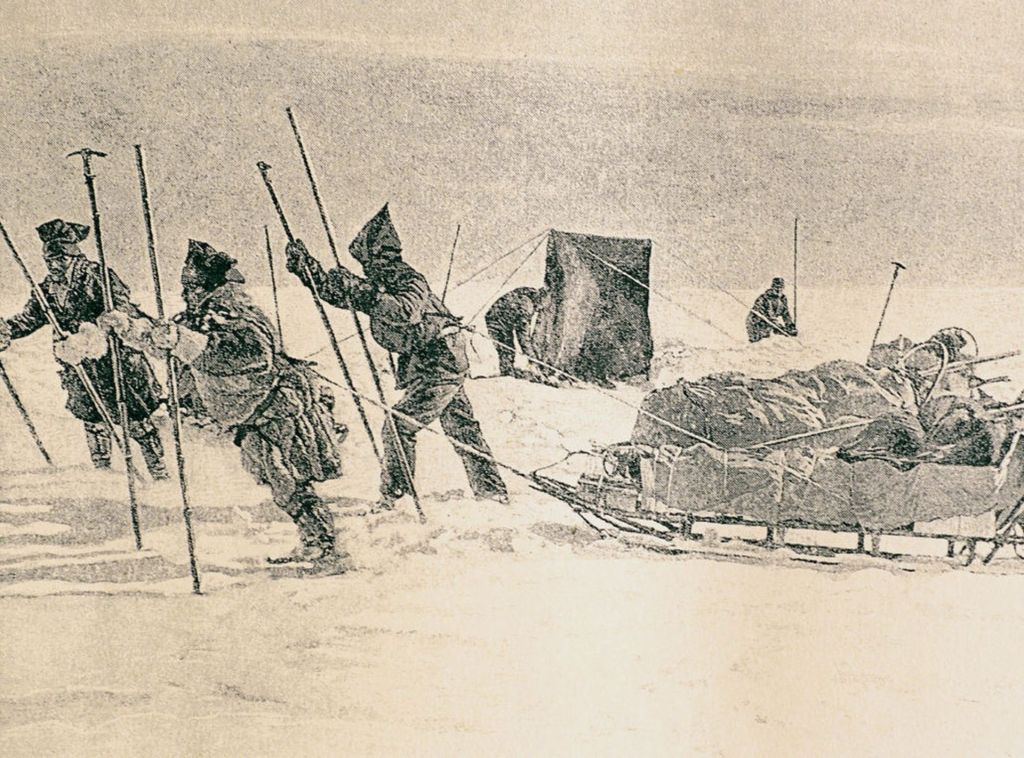
Progress was slow and grueling. Hidden crevasses, violent storms and extreme cold tested their skills and endurance. On 26 August, Nansen realised they would not reach Christianhaab in time to meet the last ship, so he changed course westward toward Godthaab, shortening the journey by about 150 kilometres. They climbed to the summit of the icecap, reaching 2,719 meters above sea level, where nighttime temperatures dropped to −45°C. Dragging sledges through fresh snow was exhausting, and the terrain remained unforgiving.
Eventually, they descended toward the fjords and Sverdrupimprovised a makeshift boat to row the final stretch. On 3 October, Nansen and Sverdruparrived in Godthaab, completing the crossing in 49 days. The remaining members followed soon after, and the explorers spent the winter in Greenland awaiting passage back to Norway. When they finally returned aboard the Hvidbjørnen in May 1889, the reception was extraordinary: tens of thousands filled the streets of Christiania (now Oslo) to celebrate their achievement.
The Greenland crossing not only cemented Nansen’s status as a pioneering polar explorer; it also helped spark a broader interest in Arctic exploration in Norway. His dramatic success and the public enthusiasm it generated were key factors in the formation of the Norwegian Geographical Society in 1889 – an organisation that would play an important role in promoting polar research and expeditions in the years that followed.
After returning home, Nansen accepted a salaried position as curator of the zoology collection at the Royal Frederick University – a role with no real duties, offered largely because the institution valued having such a renowned explorer on its staff. In the weeks after the expedition, he focused on writing his account of the journey, while also travelling abroad to share his experiences. A visit to London in June saw him meet the Prince of Wales (the future Edward VII) and address the Royal Geographical Society, where its president praised him for claiming “the foremost place amongst northern travellers” and awarded him the Society’s prestigious Patron’s Medal.
The Fram Expedition (1893–1896)
Even before completing the Greenland crossing, Nansen was dreaming of the North Pole. Inspired by meteorologist Henrik Mohn’s theory of transpolar drift and the fate of the ill-fated Jeannette expedition, Nansen reasoned that the secret to reaching the Pole was to move with the currents, rather than against them. His vision was revolutionary: a specially designed ship would intentionally become trapped in the ice near the Jeannette wreck site and drift toward the Pole.
Although experienced polar explorers were dismissive of the plans, Nansen managed to secure a grant from the Norwegian parliament after an impassioned speech. Additional funding was secured through a national appeal for private donations.
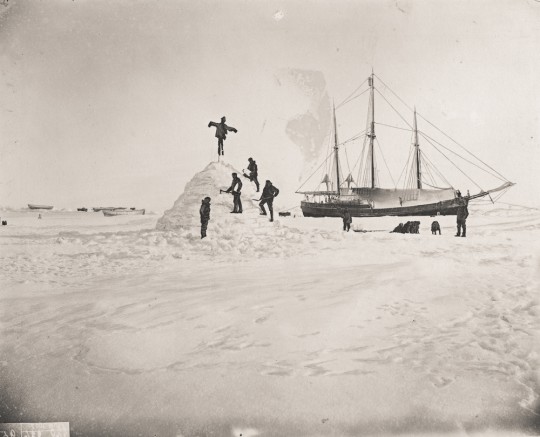
Nansen then set about enlisting Norwegian naval engineer Colin Archer to build a ship capable of surviving the Arctic ice. The resulting vessel, Fram, was uniquely robust, with a rounded hull to lift it above ice pressure, crossbeams to reinforce the structure and insulation to protect the crew from extreme cold. Speed and manoeuvrability were secondary; safety and habitability were paramount. Launched in October 1892, Fram represented a leap forward in polar engineering.
From a pool of thousands of applicants, Nansen selected twelve men, including veteran Otto Sverdrup as second-in-command. Departing Christiania in June 1893, the expedition navigated the uncharted waters of northern Siberia, passing Cape Chelyuskin and eventually reaching the area where Jeannette had been crushed. By late 1893, Fram was deliberately locked into the ice, beginning its slow drift toward the Pole. Progress was frustratingly slow at first, with the ship sometimes moving south, but by January 1894, the northerly drift had stabilised, and the crew settled in for the long haul.
Calculating that the drift could take Fram up to five years to reach the pole, Nansen devised a bold contingency. Once the ship reached latitude 83°N, he and Hjalmar Johansen would set out with their sled dogs toward the North Pole, while Sverdrup remained aboard Fram to continue its ice-bound drift until it emerged in the North Atlantic. After reaching the pole – or as far as conditions allowed – Nansen and Johansen planned to head for the nearest known land, the newly discovered and poorly mapped Franz Josef Land, then make their way to Spitzbergen to find a ship home.
With the ship’s latitude at 84°4′N and after two false starts, Nansen and Johansen began their journey on 14 March 1895. They aimed for the Pole, covering hundreds of kilometres through unrelenting ice, often fighting against hidden currents that moved the ice southward even as they skied north. On 3 April, Nansen realised the Pole itself was unattainable with their supplies and turned back after reaching a latitude of 86°13′N, almost three degrees farther north than anyone had previously reached.
The return journey was equally perilous. In their rush to break camp, Nansen and Johansen had forgotten to wind their chronometers, making it impossible to calculate their longitude accurately. For weeks, they had to rely on guesswork to navigate toward Franz Josef Land. Meanwhile, the ice itself was unpredictable: large floes shifted and broke apart under warmer weather, forcing the explorers to improvise routes and carry their sledges over unstable patches. Progress was slow and exhausting, but after weeks of hardship, they reached land in Franz Josef Land, where they spent the winter in a simple stone-and-moss shelter.
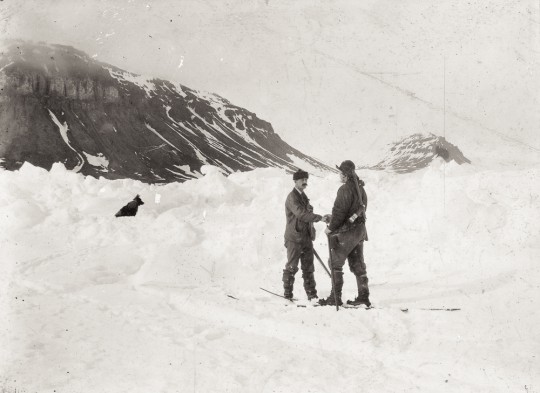
On 17 June, as Nansen and Johansen paused to repair their kayaks – recently damaged in a surprising walrus attack – Nansen thought he heard the faint sound of a dog barking, accompanied by human voices. Curious and cautiously hopeful, he moved toward the noise. Moments later, a figure appeared through the mist: it was the British explorer Frederick Jackson, leading an expedition on Franz Josef Land and camped at Cape Flora on nearby Northbrook Island. The encounter was as astonishing as it was fortuitous, bringing an abrupt and welcome end to months of isolation.
After the remarkable encounter, Nansen and Johansen were taken to Cape Flora to rest and recover from their ordeal. On 7 August, they boarded Jackson’s supply ship, Windward, and sailed for Vardø, where they were greeted with widespread celebration. Just over a week later, upon reaching Hammerfest, they received the long-awaited news that Fram had been sighted, safe and on course. The two explorers then sailed to Tromsø, where they were finally reunited with their comrades. Nansen’s achievements made him a national hero and a globally recognized authority on polar exploration. Though he retired from active expeditions, he remained a guiding figure for the exploration community, with visits to him becoming almost a rite of passage for anyone planning Arctic or Antarctic journeys. His innovative techniques, careful planning and practical equipment continued to influence generations of explorers long after he had left the ice behind.
 Forgotten Fridtjof