
Earlier this month, my home city of Bristol held its annual Balloon Fiesta – the largest hot-air balloon festival in Europe, attracting over 500,000 visitors. I have many fond memories of going as a child and watching open-mouthed as the novelty balloons rose up into the air and floated improbably above the city. I’ve always found something wonderfully Jules Vernian about hot-air balloons. Their graceful movements, extraordinary shapes and bright colours make them seem almost too fantastical to belong in the modern world.
But in Bristol, balloons are never just a Fiesta spectacle. Thanks in no small part to Cameron Balloons, based in the city since 1971, they are a familiar presence in the sky throughout the year. Although I no longer live there, whenever I land at the airport, head down the A38 and spot one on the horizon, it hits me right in the chest. For a moment, I’m a child again, staring up at the sky. I know I’m finally home.
Perhaps it’s unsurprising, then, that when I became interested in polar history, I was soon drawn to the story of S.A. Andrée, the Swedish engineer who, in 1897, made a daring attempt to reach the Geographic North Pole by hydrogen balloon. But my introduction to Andrée was, in fact, rather an unusual one!
Despite having lived in Sweden and worked at Örebro University since 2019, I had never come across his name. This struck me as particularly strange because, back in the UK, the stories of polar explorers such as Robert Falcon Scott and Ernest Shackleton are still deeply embedded in popular culture. Andrée, by comparison, seemed almost forgotten.
Then, one day, while watching Svensson Svensson – one of my favourite Swedish sitcoms – I heard Andrée’s name mentioned in a throwaway joke by the lovable but exasperating Gustav, played by the much-missed Allan Svensson. I immediately looked Andrée up. One search led to another, and before long I was completely captivated by his story, his balloon and the extraordinary fate of his expedition.
My own academic research approaches polar exploration from the perspective of material and visual culture, in line with my broader research interests. I am particularly interested in how stories of distant expeditions were communicated to audiences back home: how exploration was made visible, tangible and understandable through photographs, objects, souvenirs, publications and other material forms.
With this in mind, I wanted to use this blog post to take a closer look at five objects from the collection of the Grenna Museum in Andrée’s hometown that particularly stand out to me. Each offers a different way of thinking about Andrée and his expedition, while also revealing something about how his extraordinary story was remembered and represented.
But first, a little about Andrée himself.

S. A. Andrée: A Brief Biography
Salomon August Andrée was born in Gränna, Sweden, on 18 October 1854. He studied at the Royal Institute of Technology (KTH) in Stockholm, graduating with a degree in mechanical engineering in 1874.
His fascination with ballooning began during a journey to the United States in 1876. Andrée travelled there to attend the Centennial Exposition in Philadelphia, where he worked as a janitor at the Swedish Pavilion. During his time in America, he met the American balloonist John Wise and encountered literature on the trade winds. These experiences sparked an enduring fascination with aeronautics and, in particular, the possibility of using balloons for long-distance travel.
Back in Sweden, Andrée established a machine shop, but the venture was unsuccessful. He subsequently returned to academia, becoming an assistant at KTH and later working as a chief engineer at the Patent Office while also teaching experimental physics. In 1882-83, Andrée participated in a Swedish scientific expedition to Spitsbergen, where he was responsible for observations relating to atmospheric electricity. The expedition exposed him directly to the Arctic environment and further developed his scientific and exploratory interests.
Over the course of the next decade, Andrée began to experiment with ballooning. Between 1893 and 1895, he made nine ascents in the hydrogen balloon Svea, developing practical experience of balloon navigation and demonstrating that long-distance journeys across the Nordic region were possible. One of these journeys took him from Sweden to Finland. But Andrée had begun thinking on a much grander scale.
He became convinced that a hydrogen balloon could provide a means of reaching the North Pole. The idea was audacious: unlike traditional polar expeditions, which relied on ships, sledges and painstaking travel across the ice, a balloon could potentially carry explorers rapidly over vast distances, allowing the winds themselves to propel them towards the Pole.
The project was endorsed by The Royal Swedish Academy of Sciences, while financial backing came from prominent figures including King Oscar II and Alfred Nobel. To realise the plan, Andrée commissioned the renowned French balloon builder and aeronaut Henri Lachambre in Paris to construct a specially designed balloon. Originally named Le Pôle Nord, it was later renamed Örnen (“The Eagle”).
Andrée’s plan was to launch the balloon from Danes Island in the Svalbard archipelago. However, the first attempt, in the summer of 1896, had to be abandoned because the winds at the launch site were unfavourable. The following year, he tried again. On 11 July 1897, Andrée, together with the engineer Knut Frænkel and the photographer and physicist Nils Strindberg, finally lifted off aboard Örnen.
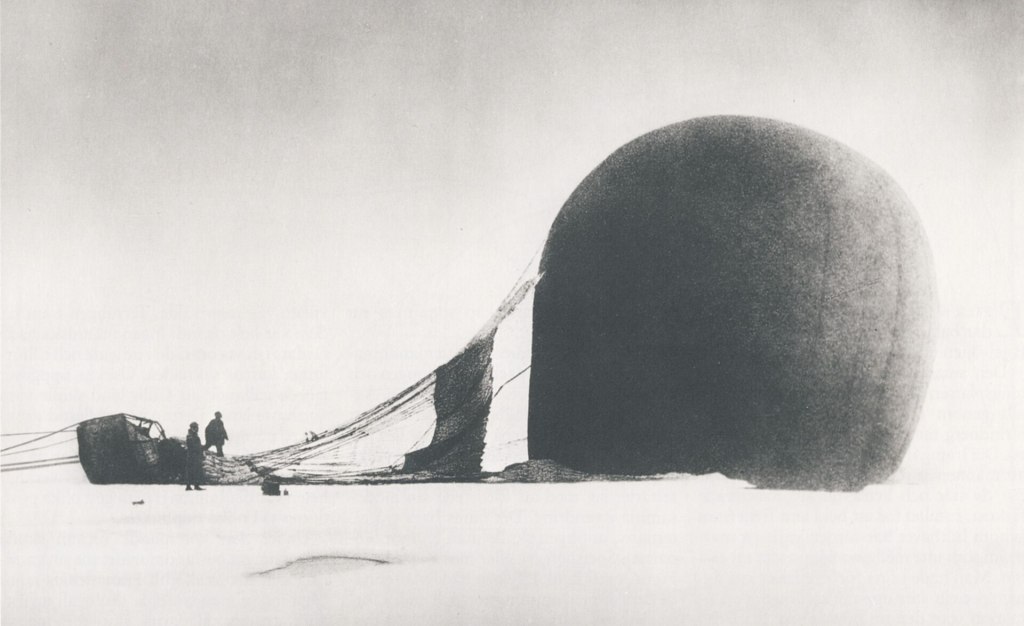
The balloon remained airborne for just 65 hours. Almost immediately, its system of guide ropes, intended to help control its movement by dragging across the ice, proved ineffective. Weighed down by fog and ice, Örnen drifted before the explorers were forced to crash-land on the pack ice, 475 kilometres from their starting point.
Their expedition, however, was far from over. Stranded in the high Arctic, the three men began a desperate journey across the drifting sea ice, initially hoping to reach Franz Josef Land. As the ice carried them in unexpected directions, they eventually turned towards northern Svalbard, but their progress was painfully slow. In early October, after more than two months travelling across the ice, they finally reached land on Kvitøya, a remote and inhospitable island in the Svalbard archipelago. By this point, they were exhausted and weakened by months of exposure and hunger.
What happened next in Kvitøya remains uncertain. All three are thought to have died within a few weeks of reaching the island, although the exact circumstances and timing of their deaths remain unknown. Their fate remained a mystery for more than three decades, until, in 1930, a Norwegian expedition discovered their final camp, together with their remains, journals, photographs and personal belongings.
It was a tragic and enigmatic end to an expedition born from remarkable ambition, ingenuity and a belief that the seemingly impossible could be achieved.
The Andrée Expedition in Five Objects
1. Commemorative Handkerchief
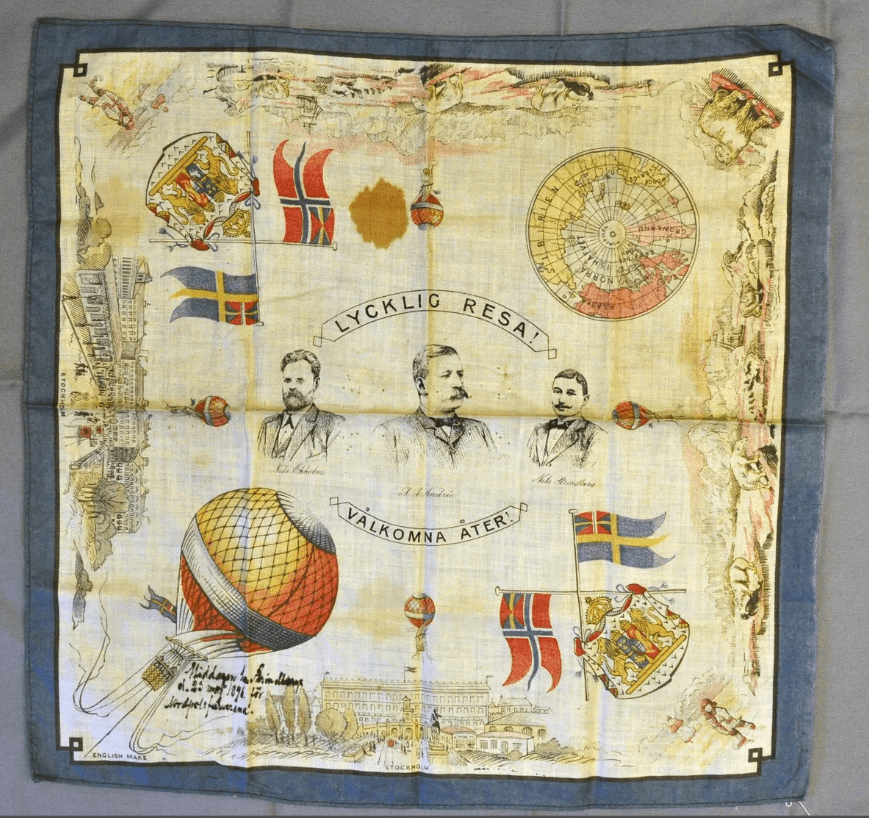
This beautifully illustrated handkerchief is one of the items that most stood out to me in the Grenna Museum’s collection. It was produced in May 1896, shortly before Andrée’s first expedition attempt, and was signed in ink during a special dinner for the explorers at Strindberg’s house on 23 May. Made from off-white fabric with a dark blue border, the handkerchief features black-and-white portraits of the three expedition members at its centre. Arched banners above and below carry the messages ‘Have a nice trip’ and ‘Welcome back’. The portraits are surrounded by four large illustrations: a prominent hot air balloon, a circular map of the North Pole, Swedish-Norwegian Union flags and coat-of-arms crests. Along the outer borders are charming vignettes of polar wildlife, icy Arctic landscapes and a city view of Stockholm with the expedition’s balloon floating overhead. Together, these elements capture the excitement, patriotism and sense of adventure surrounding Andrée’s planned journey to the North Pole.
2. Boardgame
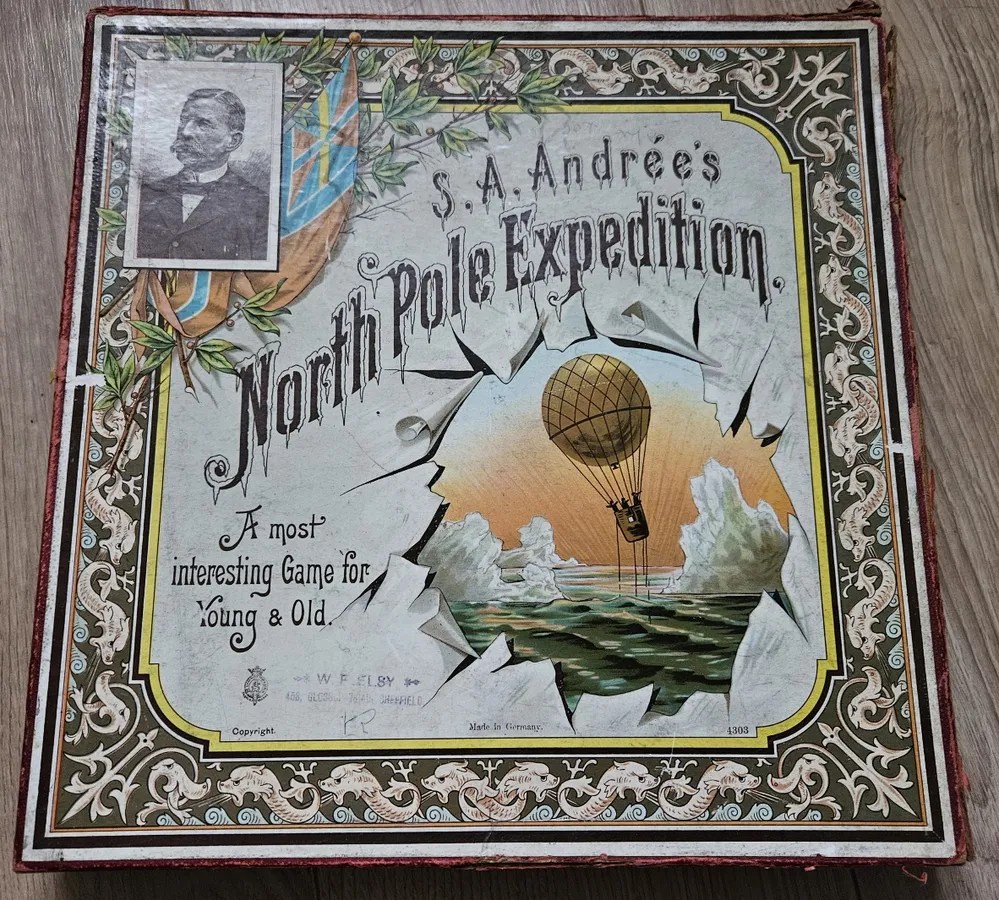
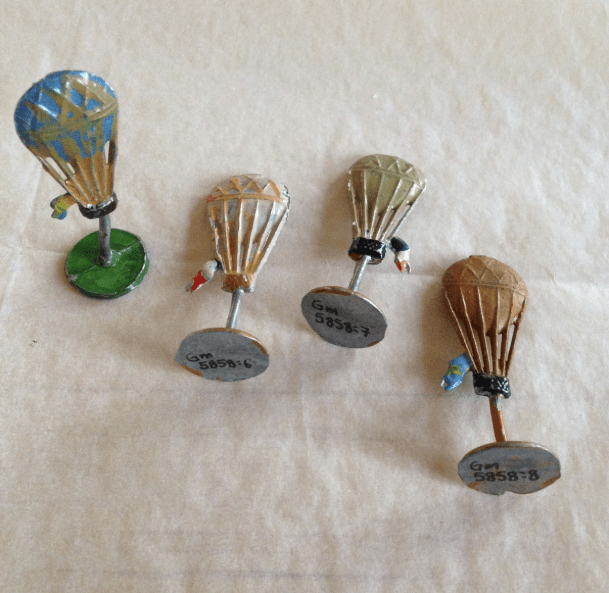
While experts in European elite scientific circles heavily critiqued the feasibility of Andrée’s proposed expedition, the general public followed the venture with intense curiosity. Given the expedition’s international attention, it was perhaps only a matter of time before it inspired a boardgame. In 1896, S.A. Andrees Nordpolexpedition was produced in Germany by Jos. Scholz Verlag and subsequently translated for the British market as S.A. Andree’s North Pole Expedition. Players could take on the role of either Andrée, Strindberg, or the French ballooning pioneers Eugène Godard or Édouard Surcouf and moved metal hot-air balloon counters across numbered circles, travelling from the surrounding landmasses towards the North Pole. The box cover drew heavily upon nineteenth-century visual conventions of the Arctic sublime, depicting a romanticised image of Andrée’s balloon drifting above an icy sea filled with towering icebergs beneath the glow of the aurora borealis. Framed by an icy Gothic typeface, decorative sea creatures, laurel leaves, flags and a portrait of the explorer, the design elevated Andrée to the status of a (inter)national hero while presenting the Arctic as a landscape of mystery, danger and conquest.

3. Advertising Cards
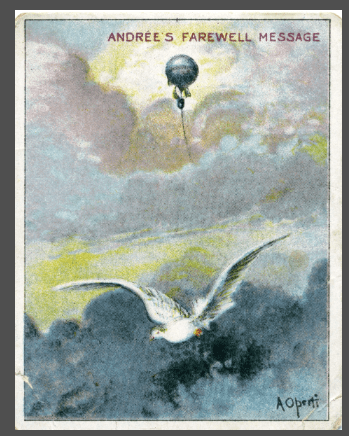
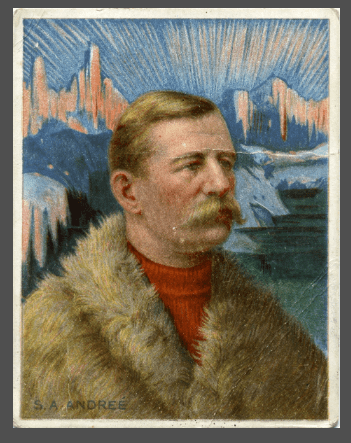
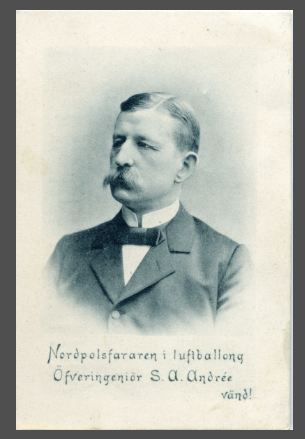
The public fascination with Andrée’s attempt to reach the North Pole also created other commercial opportunities. Companies capitalised on the expedition’s popularity by producing collectible advertising cards that associated their products with the excitement of polar exploration, scientific progress and heroic adventure. Hassan Cork Tip Cigarettes issued ornate cards illustrated by Albert Operti, which depicted key moments like the balloon floating over sea ice and the dramatic release of carrier pigeons. West End Club’s Whisky, on the other hand, produced portrait cards featuring Andrée paired with short narrative captions, while Pellerin’s Margarine used the same widely circulated photographic portrait of Andrée but added a distinct green laurel wreath. Coal importer A. Scholander & Co. instead featured a polar chart tracing Andrée’s route alongside Fridtjof Nansen’s earlier Fram expedition. The cards reveal how readily the spectacle of polar exploration could be absorbed into consumer culture, with Andrée’s image lending ordinary products an aura of adventure and prestige.



4. Sheet Music
During the late nineteenth century, sheet music sat at the centre of middle-class domestic entertainment, driving a thriving culture of parlour music where families gathered around the piano to play the latest popular tunes. Major events were routinely turned into musical novelty pieces; publishers had previously produced widely circulated sheet music to celebrate Fridtjof Nansen’s Greenland crossing and Fram expedition, and Andrée’s venture proved no different. The most famous of these tributes was Vid Nordpolen (‘At the North Pole’), a lively polka for piano composed by Ad. Nordholm and released by the Stockholm publishers Elkan & Schildknecht. Its cover art offers a whimsical fantasy of success, depicting Andrée and Strindberg standing triumphantly at the Pole while their balloon, Örnen, hovers safely above. In the foreground, the scene dissolves into playful celebration: polar bears act as a musical ensemble playing instruments, while Inuit figures in heavy fur parkas dance across the ice. The main title is drawn in a stylised, jagged font that visually mimics frozen blocks of ice, reinforcing the polar motif. By blending light-hearted humour with heroic achievement, the piece transformed the expedition into an entertaining novelty, allowing everyday citizens to bring its collective excitement directly into their homes.

5. Memorial Plaques
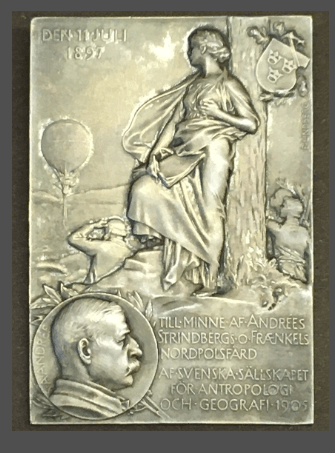
The final pieces are more sombre: two memorial plaques produced following the expedition’s disappearance, when the men were presumed dead. The silver commemorative plaque was issued in 1905 by the Swedish Society for Anthropology and Geography and relies on classic allegorical motifs to canonise Andrée’s expedition. A draped classical figure leans against a tree holding a sheet of paper and pen, flanked by the Swedish coat of arms. She gazes upwards toward the sky where Örnen ascends, while an observer in the middle ground shields their eyes to track its launch. A profile portrait of Andrée rests in the bottom corner framed by laurel leaves, accompanied by a formal inscription dedicating the plaque to the memory of Andrée, Strindberg and Frænkel. The other plaque is carved from wood and was produced in Romania under the title ‘The Odyssey of the Swedish Spherical Balloon Örnen 1897’. At the centre of the relief is the Greek figure Icarus above the Latin inscription ‘Pro-Memoria’. To the left, a bird in flight appears beneath the balloon, while another scene depicts Örnen drifting over icy waters towards the distant horizon. The names of all three crew members are carved into the relief, framing the expedition not merely as a scientific venture, but as an epic, mythic saga of human ambition.

 Forgotten Fridtjof
Leave a comment