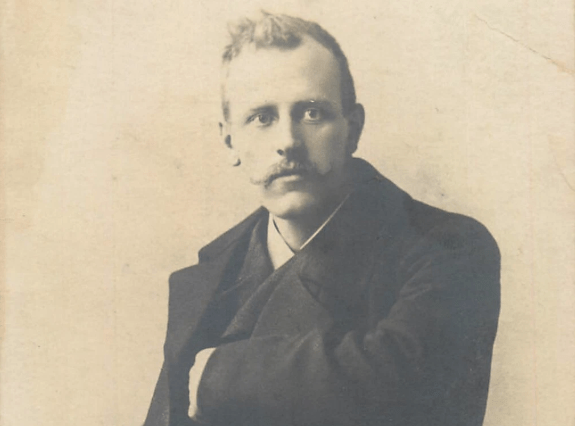
In a previous blog post, I posted an extract from the Illustrated London News reporting on Nansen’s lecture tour in 1897. I shared it because it was so wonderfully vivid, and the author captured perfectly why Nansen was so warmly received and widely admired in Britain.
Well, today I’ve found another piece that might even top it. It was written by the American correspondent Poultner Bigalow for Harpers’ Weekly (6 March 1897) and brings such a smile to my face with its gushing language. Bigalow is really simping for Nansen here!
Foreign Notes
From an American Point of View
London, February 10, 1897
It is worth while being a Fellow of the Royal Geographical Society on a Nansen night, as I discovered to my huge satisfaction on the evening of the 8th, when with twelve thousand others I crowded into one of the largest auditoriums in the world for the sole purpose of cheering the plucky Norwegian for the perils he has survived. Every American visiting London remembers the gorgeous monument to Prince Albert, so suggestive of Oriental idolatry. The Albert Hall is the huge circular building opposite to it. It is associated in my mind with the Roman Coliseum and the Salt Lake Mormon Tabernacle. For half a mile before we reached its doors we seemed to be in a procession made up of every wheeled vehicle of the metropolis, concentrating on one point. As the night was characteristically rainy, I calculated that at least five thousand horses were employed in dragging the wheels of those who came to honor Nansen. Had Albert Hall seated ten times twelve thousand people the scene would have been the same, only ten times more so.
The hall was brilliantly lighted, and my eyes are strong, but it was with the greatest difficulty that I could distinguish such familiar figures as those of the Prince of Wales and the President of the society. The audience had no more individuality to me than the regiments and divisions of the German army when sixty thousand men are massed within a few acres for the purposes of a review.
On either side of me, in the boxes, sat ladies dressed as for the opera, whose escorts looked like men given to thinking seriously. From such generalization as is possible to one who could see but a very small fraction of the whole, I venture to think that the audience which gave Nansen his first official greeting represented a large share of our accumulated knowledge in science, art, commerce, and literature. The Royal Geographical Society does for England what our Geographical Society in Twenty-ninth Street does for America, each according to its means and opportunities. There are about four thousand Fellows on the London society’s list, and in its treasury are ample funds for the encouragement of scientific travellers. Its meetings are usually held in its own building, behind the Royal Academy, but on special occasions it hires the largest hall that can be secured. When Stanley came back from Africa, Albert Hall had to be engaged, but since then no geographical record has been made comparable to Nansen’s. Stanley was an American citizen, though he has since made himself an Englishman. It is worth noting that the two greatest geographical celebrations held in London in these latter days have been occasioned by non-English explorers. This serves to illustrate an excellent side of English character – the unselfish and generous applause he is willing to give to such as have honestly earned it.
The presence of the Prince of Wales and the Duke of York gave this meeting of the Geographical Society some of the quality inseparable from a courtly function. It was significant that the sovereign of this empire should command the heir to the throne to participate in such a function as this, dressed in the plain evening dress of the average English gentleman, and exercising privileges, not by virtue of royal prerogative, but as an official in this learned society. I try to picture a corresponding event in the capitals of the military great powers, but I cannot do so without conjuring up an array of helmets, sabres, uniforms, and grand-marshals of ceremonies whose duty it is to see that vulgar mortals do not breathe too near the atmosphere of royalty. Such a scene as I witnessed in Albert Hall would have been simply impossible in Berlin, even under a monarch so intelligent and alive to geographical expansion as William II. The Kaiser himself would have relished playing the part of the Prince of Wales on this occasion, but not in Germany. In England the Prince of Wales is a gentleman amongst gentlemen, but in Germany the Kaiser has to be a soldier over a people who don’t know what a gentleman is until he buckles on a sword.
Nansen is a Viking come to life, that we, latter-day degenerates, may have a taste of the blood that bounded in our ancestors. The best type of white manhood that I know is to be found far up along the Norwegian coast, amongst those hardy Norsemen who sail their open boats out into the storms of the Atlantic, and do daily deeds of courage that are unnoticed because so common. If we could imagine the Apollo Belvedere looking less like a flabby flunky, and more like a boating-man in training we could get near to appreciating the manly beauty of this explorer. His shoulders and head and neck are so well proportioned and poised that I found myself merely staring at him with no other feeling than delight in the proportions of a perfect man. As he stood by the Prince of Wales, receiving the costly gold medal which had been struck in his honor, we could note how greatly he towered over those about him; nor is the Prince of Wales a singularly short man.
Nansen left upon me the impression of a singularly harmonious mind, reposing in and controlling a singularly harmonious body. In Irving’s Life of Washington there is a picture of a tall, dignified, self-contained, self-controlling, and yet enthusiastic gentleman, who inspired confidence and affection wherever he chose to seek it, and who occupied the leading place in his country’s history merely because he lived and died faithful to his moral ideals. Such is the impression left by this Norwegian – an impression created by a dozen things which he did not say or do. He did not brag; he did not criticise others; he claimed nothing, but spoke as though his gallant crew had selected him as their mouthpiece to tell, in simplest language, the facts of their long cruise in the Arctic. Nansen’s voice is like music, rich and deep. It would carry for miles, and reach a sailor on the royal in a gale of wind, yet can modulate to a melodious cadence, as, for instance, when, last night, he told about his Christmas spent in a stone hut, constructed by himself and his only companion; when his thoughts reverted to the Christmas tree at home, and the little children clapping their hands and dancing about in happy anticipation. There was not a creature in Albert Hall that could not hear every word that fell from his lips, and this without the slightest raising or straining of his natural voice. Throughout the evening I kept marvelling at his constant exhibition of modesty and good taste in the selection and treatment of his episodes. He had a hundred opportunities for tactless remarks, but he never utilized a single one. Had he been reared in diplomacy he could not have more pleased those who listened. There was in his delivery no sign of embarrassment, no hurrying, no repetition, none of the dreary dragging so common on these occasions.
It was no surprise to hear Nansen discoursing in English, for from my experience of Norwegians I am inclined to think that the proportion of people in that country who speak English is larger than in any other country of the world. The American in Norway will probably understand most of the people he is apt to meet there better than he would the peasants of many parts of the British Islands, notably Ireland, Wales, and Scotland. Every Norwegian is directly or indirectly connected with boats, and the proportion of those who have sailed in American yachts or English merchantmen is very large indeed. But the remarkable part of Nansen’s performance was that in his English discourse, lasting more than an hour, there was not a single adjective too many, not a single term obscure, not a single sentence that was not direct, forcible, and complete. I venture to think that few Englishmen of letters could have produced a literary composition so creditable to their mother-tongue as did this Dr. Nansen in a language not his own.
We often say of a friend that he speaks a foreign language like his mother-tongue; but in most cases, if not In all, this is more complimentary than truthful. I have met many such people, who, reared in the diplomatic profession, have shown complete fluency in reading and writing other languages, but in no case have I known them to deceive an educated person. For my part I have no sympathy with an American’s ambition to speak like an Englishman, or like a Frenchman, or like a German. Many people told me that Nansen spoke English like an Englishman, but that is absurd, unless reference is made to some English tribe which I have not yet met. Nansen discloses his Scandinavian origin the moment he opens his mouth. His mere pronunciation of the famous Fram reveals him a Scandinavian, and he cannot pronounce a single “o” or “n” without betraying the force of the mother tongue. Can we not all recall the beautiful Mod Jeska, the Polish actress, who charmed us with an English all her own? Those who beard her would not have exchanged her English for any other, and I am sure this is also our feeling about Nansen. POULTNEY BIGELOW
—–
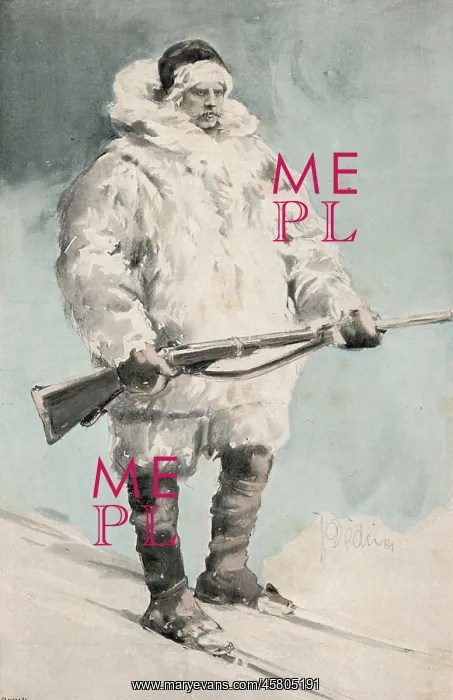
And on a humorous endnote, this illustration made me laugh way more than it should have. I had visions of George Constanza and his big coat, if you’re old enough to get the Seinfeld reference!
 Forgotten Fridtjof
Leave a comment